I came across a death record of my 2nd great grand uncle, Arthur Conroy, who died in Billerica, MA in 1864 at the age of 24. Listed as the cause of death was "Acute Peritonitis". Peritonitis can be a complication of cirrhosis of the liver, or it can caused by bacteria spilling into the abdominal cavity, either because of an ulcer, rupture or injury of some kind.
One year after Arthur died, his sister Rachael gave birth to a son out of wedlock. She named him Arthur, no doubt as a tribute to her late brother. In 1899, Arthur Conroy was shot dead by a woman who mistook him for an intruder, as he drunkenly tried to get into her house in the middle of the night. He was 33.
Showing posts with label Mahoneys. Show all posts
Showing posts with label Mahoneys. Show all posts
Monday, July 25, 2011

Friday, May 13, 2011
The Weaver
In a 1901 Billerica town directory, Mary Jane was listed as "Widow of Cornelius, Weaver, 15 Lowell Street". She was a mother to 4 children, and held down work in the mills.
She was born Mary Jane Cox to John and Mary Cox in Fermanagh, Enniskillen, Northern Ireland and left to come to the US, on her own, when she was just 15. Her brother John stayed behind in Enniskillen to start a family. He was her only relation that we are aware of.

She listed her year of immigration as 1873, and she married Cornelius McCusker in Lowell on May 7th, 1880. She and Cornelius show as borders on 44 Williams Street in Lowell on a 1880 census with a Devlin family. They were surrounded by other young Irish immigrants who found work in the Mills.

Mill work was dusty, monotonous and loud. Very loud. An operative in one of the mills wrote about how life in the mills wasn't all bad. Methinks she doth protest too much:
The work was drudgery and the hours exhausting. They worked six days a week, twelve hours a day. They got out "early" on Saturdays when the dismissal bell rang at 5:00 pm.

But the work allowed her to save enough to help her daughter with a down payment on a house years later. And she was known to send money back to her brother in Ireland.
Mary Jane was widowed in 1896 when Cornelius died at age 38. By this time they were living in Billerica. The 1910 census says that she had 5 children, 4 of them still living.
She would lose 2 of those 4 surviving children during the 1917/1918 epidemic. Etta and Joseph were in their 30's when they passed away. Uncle Vin's memoirs says there is reason to believe the cause was possibly the Spanish Flu which was quite lethal at that time, but I have not been able to find their death records online to verify.
In 1930 she was 69 and living with her daughter, my grandmother Anna R. and grandfather Frank Mahoney in North Billerica. My uncle Vinny remembers her this way:
She was born Mary Jane Cox to John and Mary Cox in Fermanagh, Enniskillen, Northern Ireland and left to come to the US, on her own, when she was just 15. Her brother John stayed behind in Enniskillen to start a family. He was her only relation that we are aware of.

She listed her year of immigration as 1873, and she married Cornelius McCusker in Lowell on May 7th, 1880. She and Cornelius show as borders on 44 Williams Street in Lowell on a 1880 census with a Devlin family. They were surrounded by other young Irish immigrants who found work in the Mills.

Lowell Mill girls, 19th century
Mill work was dusty, monotonous and loud. Very loud. An operative in one of the mills wrote about how life in the mills wasn't all bad. Methinks she doth protest too much:
Pleasures, did you say? What pleasures in factory life? From many scenes with which I have become acquainted, I should judge that the pleasures of factory life were like "Angels visits, few and far between"-said a lady whom fortune had placed above labor. I could not endure such a constant clatter of machinery, that I could neither speak to be heard, nor think to be understood, even by myself. And then you have so little leisure-I could not bear such a life of fatigue. Call it by any other name rather than pleasure.
But stop, friend, we have some few things to offer here, and we are quite sure our views of the matter are just, having been engaged as an operative the last four years. Pleasures there are, even in factory life; and we have many, known only to those of like employment. To be sure it is not so convenient to converse in the mills with those unaccustomed to them; yet we suffer no inconvenience among ourselves. But, aside from the talking, where can you find a more pleasant place for contemplation?I'm sure I could come up with a few.
The work was drudgery and the hours exhausting. They worked six days a week, twelve hours a day. They got out "early" on Saturdays when the dismissal bell rang at 5:00 pm.

The work schedule for the mills. From 6:30 am to
6:30 pm with a half an hour for lunch.
But the work allowed her to save enough to help her daughter with a down payment on a house years later. And she was known to send money back to her brother in Ireland.
Mary Jane was widowed in 1896 when Cornelius died at age 38. By this time they were living in Billerica. The 1910 census says that she had 5 children, 4 of them still living.
She would lose 2 of those 4 surviving children during the 1917/1918 epidemic. Etta and Joseph were in their 30's when they passed away. Uncle Vin's memoirs says there is reason to believe the cause was possibly the Spanish Flu which was quite lethal at that time, but I have not been able to find their death records online to verify.
In 1930 she was 69 and living with her daughter, my grandmother Anna R. and grandfather Frank Mahoney in North Billerica. My uncle Vinny remembers her this way:
Grandma McCusker was a very nice woman. I remember her well. She was a quiet, kind woman who minded her own business, a woman who certainly couldn't have had a very soft life.
Physically, Mary Jane was a fairly tall and spare woman. She had a good sense of humor, but a very subtle laugh, almost a chuckle. I never remember her roaring with laughter like the Mahoneys.
Things, mostly little things that I remember about Mar' Jane (pronounced by her friends as "Mare Jane "): her hair bun almost on top of her head,(I swear Grandma and mother both called these "pugs". Perhaps it's an old Irish expression?) her metal rimmed glasses; her long slim, wrinkled aging fingers; her gold tooth (only one I think, but she had her own teeth until she died.)
She and mother took me to Lowell occasionally. On one occasion they took me to a Chinese restaurant roughly located at Merrimack and Central upstairs over the "Five and Ten". I was probably under 5 years old, and I was scared to death. It was not only the looks of the Chinese and the fact that their English was barely understandable (although that was a lot of my problem) but the booth with the glass bead curtains or whatever they were plus the food, to which I was absolutely new - all in all it was too much. I don't imagine mother and Grandma had a very enjoyable meal!
[But] Grandma McCusker was always "there " with Christmas and birthday gifts for Henry and me. Things like sheepskin coats and snow boots.
She was a great Grandma.
Tuesday, May 10, 2011
The White Whale
Cyrus Ham (if that is his real name) is the elusive relation who seems to frustrate every effort to track him down. My frequent and abrupt hiatuses from genealogical research are usually due to banging my head against a brick wall in my search for this man.

UPDATE: Ahab, here. Progress made, updates coming.....

Not Cyrus, but a close depiction of my mental image of him.
Cyrus Ham was a farmer, born in Rochester, New Hampshire in 1818. His surname suggests that he was born into a family with roots that extend to the very founding of the city itself. Eleazar Ham was the second settler in Rochester which was founded in 1728. By 1738 there were sixty families centered near Haven Hill, banded together to fend off Indian attacks, which were frequent enough to prompt officials to offer a $100 bounty on Indian scalps.
With what could potentially be a very prominent family, I expected some pretty meaty records. To list off the attempts that ended in failure would bore the most ardent genie, but suffice it to say that all searches online and visits to Vital Records in Concord and Rochester have been fruitless.
In my frustration at finding anything on Cyrus himself, I decided to "go sideways" and see if I could find a route through siblings. His will mentions his sister's daughter Jennie Twombly, and from there I found his sister's name Lucy Swain. Lucy Swain's death certificate states her parent as Eleazar Ham. This is tantalizingly close, but the dates for Eleazar the founder and Eleazar the parent don't match. Not even close. It may be one is the descendant of the other, but that conclusion will require more proof than I have right now.
What I do know about Cyrus is that he at some point moved to Billerica, Massachusetts and married Julia Ann Wood from Chelmsford. In 1870, he was a 51 year old farmer with personal worth of $6500, or about $110,000 in today's dollars. He had one son, Foster, who served during the Civil War, and an adopted daughter, Ella, who was my great grandmother. (Adopted from whom? Let's say I have my suspicions.) Foster's son Frank also lived with the family at that time, as Foster seemed to be having marital difficulties.
It was likely due to these difficulties that Cyrus put into play restrictions on his will that would impact Massachusetts State Law. In an attempt at keeping the detested daughter-in-law from sharing in the estate, he provided that his son Foster would be the executor, but not inheritor of his estate, unless or until the daughter-in-law was dead or divorced. The plaintiffs in the ensuing court case maintained that this was unfair and/or illegal and it eventually made it all the way to the Massachusetts Supreme Court, who ruled that it was neither.
Just as Robbie Burns wrote "The best laid schemes o' Mice an' Men often go awry" so too did the will of Cyrus backfire. Pretty spectacularly in my estimation. Foster died before he could divorce. There was a provision that Cyrus' niece should receive the estate should Foster not survive to claim it, probably in the belief that she would filter the money to the grandson without any getting passed onto the child's mother. While the will was being contested, the niece died suddenly (obstruction of the bowels) while in her 30's, and the whole estate passed to her husband's family, who apparently weren't of the mind to share it. Cyrus' grandchild, who Cyrus may have believed would be taken care of by his niece, received nothing of the family estate.
Just as Robbie Burns wrote "The best laid schemes o' Mice an' Men often go awry" so too did the will of Cyrus backfire. Pretty spectacularly in my estimation. Foster died before he could divorce. There was a provision that Cyrus' niece should receive the estate should Foster not survive to claim it, probably in the belief that she would filter the money to the grandson without any getting passed onto the child's mother. While the will was being contested, the niece died suddenly (obstruction of the bowels) while in her 30's, and the whole estate passed to her husband's family, who apparently weren't of the mind to share it. Cyrus' grandchild, who Cyrus may have believed would be taken care of by his niece, received nothing of the family estate.
UPDATE: Ahab, here. Progress made, updates coming.....
Friday, May 6, 2011
The Shortstop
My great grandfather Henry J. Mahoney was six years old in 1869 when the National Association of Base Ball Players established a "professional" category. His mother had just remarried that year after having been a widow for five years. Henry was Bridget (Conroy Mahoney) McNulty's only surviving son, and her first child born on U.S. soil. He had three older sisters, one younger sister, and would soon have two half-sisters.
The Boston Red Stockings dominated the newly formed professional leagues in those first seasons, and the popularity of the game was spreading rapidly. "Major League" more likely designated the size of the city, rather than the caliber of the players at that point, and leagues of players were popping up all over the East Coast. Henry was active in organizing the local Athletics team, became a fixture on the Blue Stockings, and later made a name for himself as one of the best known players in Middlesex county as a shortstop on the T.R&T. Nine. It was said that he was offered a spot on a Major League team, but he declined.

Uncle Vinny remembers seeing pictures of his grandfather's teams, with most of the players sporting mustaches and gloves with the palms cut out for a better grip. It was during these playing days that Henry acquired a new moniker: "Steve". Apparently, the nickname had something to do with his persistence in taking chances on the diamond. Stealin' Steve Mahoney? Whatever the reason, it stuck. He was also known in his playing days for colorful chatter to opposing fans in the stands.
Henry was a firefighter for his hometown of Billerica, MA. He was already serving as a volunteer when the town purchased their first steam engine, and he earned renown for being able to "get up steam" in 3 minutes. In the 1940's he received a gold medal from his fellow firemen for 50 years of dedicated service, rarely missing a call out in all that time.
In 1883, at the age of 20, Henry married Mary Ella Ham (Ella, as she appeared on the census). She was a local girl, same age, who lived with a well off Protestant family in town. After the marriage, her parents disowned her - or at least, cut her out of the not-insignificant family will. Whether it was because Henry was Catholic, or Irish, or both isn't clear now. But Henry and Ella went on to have five children. Ella passed away not long after her last child, a son named James, was born. The child James died soon after.
Within a few years, Henry was also to lose a cousin in what seemed to be a tragic accident. Arthur Conroy was 28 when he was shot by a woman as he attempted to enter her home in the middle of the night. Apparently he had been drinking and had mistaken the house for a friend's. It was cold, he was drunk, and the last street car had left for the evening. It is assumed that he thought he might ask his friend to spend the night. However, the woman was home alone with small children, and believed that she was facing more than one intruder, as she heard Arthur talking to himself as he tried to get into her front door. She shot him through the glass door, apparently at quite close range, and he died instantly.

The woman, Letitia Blennerhasset, was held on $1500 bail pending a trial for manslaughter. I haven't yet discovered what the verdict was.
After Ella died, Henry J. was about 35 years old with four children to raise. The youngest, Isabelle, was two years old. He hired a series of housekeepers to assist, but one in particular was more than a hired hand. Enter Catherine "Nonnie" Cain. She became a surrogate mother to the Mahoney clan, and Henry married her a few years later. Nonnie went on to become a beloved grandparent to the next generation of Mahoneys.

And it was as a grandfather that "Steve" truly excelled. Vinny fondly remembers Grandpa Steve taking him as a child to the firehouse to try on helmets and show him the equipment. And although he was often reproved for it by his son Frank (my granddad), Grandpa Steve enjoyed a pipe and beer on a regular basis. As Vinny noted, it didn't seem to do him any harm, as he was one of the longer lived relatives of the day, reaching the ripe age of 78 when he died in 1942.
A popular song from the era of his birth (1863) was "When Johnny Comes Marching Home Again" and "Battle Hymn of the Republic". Hits from the year he died included "American Patrol" and "The White Cliffs of Dover". He was born in the middle of the US Civil War, and died during WWII. And in between he witnessed the advent of typewriter, telephone, combustion engine, the zeppelin, teddy bear, safety razors, the airplane, penicillin and bubble gum (in that order). He died before the atom bomb, TV, and microwave ovens.
The Boston Red Stockings dominated the newly formed professional leagues in those first seasons, and the popularity of the game was spreading rapidly. "Major League" more likely designated the size of the city, rather than the caliber of the players at that point, and leagues of players were popping up all over the East Coast. Henry was active in organizing the local Athletics team, became a fixture on the Blue Stockings, and later made a name for himself as one of the best known players in Middlesex county as a shortstop on the T.R&T. Nine. It was said that he was offered a spot on a Major League team, but he declined.

Uncle Vinny remembers seeing pictures of his grandfather's teams, with most of the players sporting mustaches and gloves with the palms cut out for a better grip. It was during these playing days that Henry acquired a new moniker: "Steve". Apparently, the nickname had something to do with his persistence in taking chances on the diamond. Stealin' Steve Mahoney? Whatever the reason, it stuck. He was also known in his playing days for colorful chatter to opposing fans in the stands.
Henry was a firefighter for his hometown of Billerica, MA. He was already serving as a volunteer when the town purchased their first steam engine, and he earned renown for being able to "get up steam" in 3 minutes. In the 1940's he received a gold medal from his fellow firemen for 50 years of dedicated service, rarely missing a call out in all that time.
In 1883, at the age of 20, Henry married Mary Ella Ham (Ella, as she appeared on the census). She was a local girl, same age, who lived with a well off Protestant family in town. After the marriage, her parents disowned her - or at least, cut her out of the not-insignificant family will. Whether it was because Henry was Catholic, or Irish, or both isn't clear now. But Henry and Ella went on to have five children. Ella passed away not long after her last child, a son named James, was born. The child James died soon after.
Within a few years, Henry was also to lose a cousin in what seemed to be a tragic accident. Arthur Conroy was 28 when he was shot by a woman as he attempted to enter her home in the middle of the night. Apparently he had been drinking and had mistaken the house for a friend's. It was cold, he was drunk, and the last street car had left for the evening. It is assumed that he thought he might ask his friend to spend the night. However, the woman was home alone with small children, and believed that she was facing more than one intruder, as she heard Arthur talking to himself as he tried to get into her front door. She shot him through the glass door, apparently at quite close range, and he died instantly.
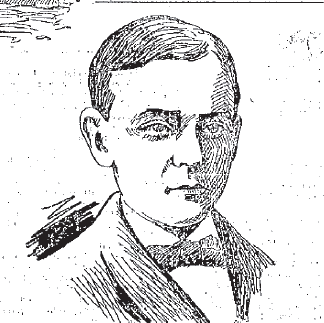
Henry J. was a pall bearer for his cousin Arthur Conroy in 1899
The woman, Letitia Blennerhasset, was held on $1500 bail pending a trial for manslaughter. I haven't yet discovered what the verdict was.
After Ella died, Henry J. was about 35 years old with four children to raise. The youngest, Isabelle, was two years old. He hired a series of housekeepers to assist, but one in particular was more than a hired hand. Enter Catherine "Nonnie" Cain. She became a surrogate mother to the Mahoney clan, and Henry married her a few years later. Nonnie went on to become a beloved grandparent to the next generation of Mahoneys.

Henry J. aka Grandpa Steve (last on right) with Nonnie (center)
and Isabelle's in-laws on Isabel's wedding day, 1923
And it was as a grandfather that "Steve" truly excelled. Vinny fondly remembers Grandpa Steve taking him as a child to the firehouse to try on helmets and show him the equipment. And although he was often reproved for it by his son Frank (my granddad), Grandpa Steve enjoyed a pipe and beer on a regular basis. As Vinny noted, it didn't seem to do him any harm, as he was one of the longer lived relatives of the day, reaching the ripe age of 78 when he died in 1942.
A popular song from the era of his birth (1863) was "When Johnny Comes Marching Home Again" and "Battle Hymn of the Republic". Hits from the year he died included "American Patrol" and "The White Cliffs of Dover". He was born in the middle of the US Civil War, and died during WWII. And in between he witnessed the advent of typewriter, telephone, combustion engine, the zeppelin, teddy bear, safety razors, the airplane, penicillin and bubble gum (in that order). He died before the atom bomb, TV, and microwave ovens.
Subscribe to:
Posts (Atom)